The short answer
A realistic recruitment area for technical professionals starts not with a radius on a map, but with where the work actually takes place. Project locations, office frequency, and attendance requirements together determine what commute time is acceptable. Only then does it make sense to see how many candidates live within that range – and whether they are willing to cover that distance.
Bring your role, region and essential criteria. In 30 minutes, we explore how to reach technical people who are not actively looking and which approach could fit your vacancy.
Start with the work, not the office
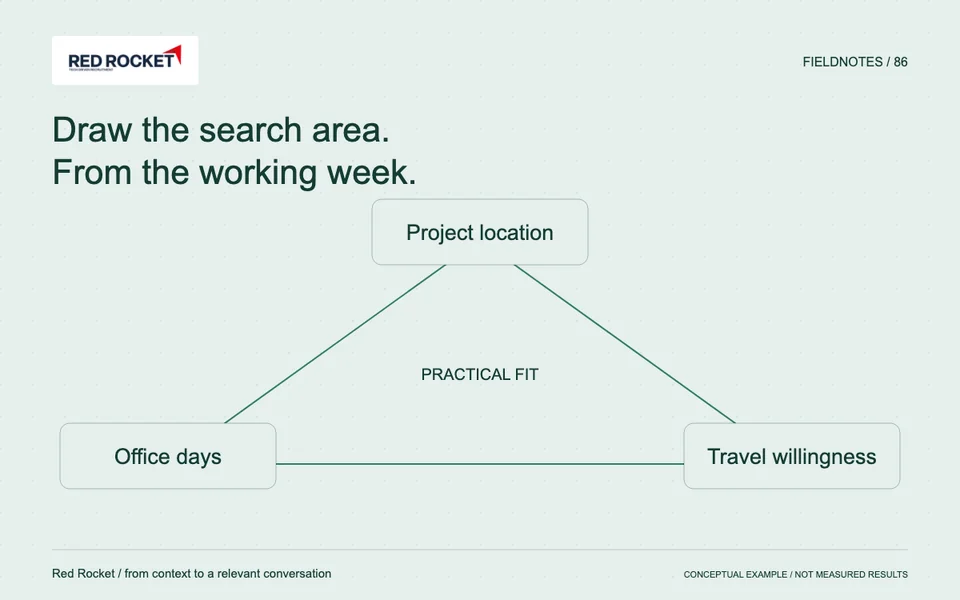
Technical professionals often work at varying project locations. A site manager might drive to a construction site in the region on Monday and to a location two provinces away on Thursday. The recruitment area must align with that reality. First, establish: where are the projects located, how often is office attendance required, and what is the expected daily commute time?
Commute time as the measure, not postcode
A candidate 40 kilometres away might reach the location in 35 minutes via a motorway. A candidate 20 kilometres away could be travelling for an hour during rush hour. Use commute time – not postcode or kilometre radius – as the primary measure. Explicitly determine the maximum acceptable commute time for the role, and test that against the project locations.
Attendance requirements make or break the reach
Five days a week at one fixed location requires a different recruitment area than two days in the office combined with project visits. The more flexible the attendance requirements, the larger the realistically reachable area. Concretely define attendance expectations before you define the recruitment area – otherwise, you're comparing apples and oranges.
Fictional example: a triangle as the framework
Suppose a contractor in Eindhoven has projects in Tilburg, Den Bosch, and Helmond. Office attendance is required one day a week. The triangle between these three cities – with a maximum commute time of 45 minutes – forms the real recruitment area. Candidates outside that triangle are not necessarily unreachable, but require an explicit willingness check during the interview.
Align channel and campaign with the area
Once the recruitment area is clear, you determine how to reach that area. Red Rocket tailors campaigns to the organisational context and the geographical reality of the role. The AI recruiter conducts the initial interview and maps out commute willingness and attendance expectations. Assessment and decision-making remain with you as the employer or recruiter. Schedule a call to test your recruitment area. For more insight into how job seekers value contact with employers, see UWV – Job seekers want easy contact with employers.
Frequently asked questions
Can I include a maximum travel distance in kilometres in my vacancy?
Describe the work and project locations and the necessary attendance. Let candidates explain their travel arrangements. An arbitrary distance limit does not establish whether someone can do the work; discuss why such a requirement matters.
What if suitable candidates live outside my recruitment area?
Do not exclude them in advance. During the interview, test whether they are willing to make the commute. Some professionals accept a longer commute for the right role or project environment.
How does working from home relate to the recruitment area for technical professionals?
Technical professionals largely work on-site. Working from home plays a limited role. The recruitment area is primarily determined by project locations and the frequency of office or construction site attendance, not by the possibility of working from home.