The short answer
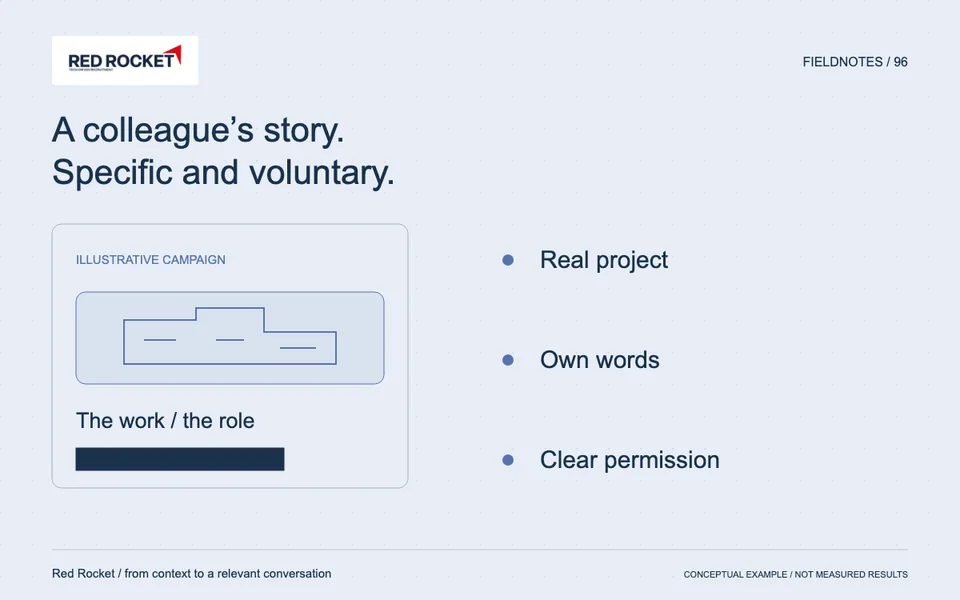
Credible employee stories happen when people voluntarily share something genuine about their work – not when they read out a prepared recommendation. Choose employees who are enthusiastic about a specific project, ask permission before publishing, and be honest about what the role involves. That attracts candidates who know what they're signing up for.
Bring your role, region and essential criteria. In 30 minutes, we explore how to reach technical people who are not actively looking and which approach could fit your vacancy.
Voluntary participation as the starting point
Imposed recommendations sound hollow – candidates see straight through them. Only ask employees who express a genuine interest in contributing. A quick check-in with the team is enough. Those who hesitate simply don't take part. That's fine: one honest story carries more weight than five reluctant quotes.
Concrete projects as the hook
Abstract job descriptions convince nobody. Let employees talk about a specific project: what was the challenge, what decisions did they make, what did they learn? A practical example: a planning coordinator describes how he rescheduled an entire project after a delivery problem. That tells candidates far more about the role than a list of requirements.
Permission and editorial control
Agree upfront on how the contribution will be used: on the website, in a campaign, or only internally? Let the employee approve the final text or video clip before publication. That keeps the message on track and respects the contributor's boundaries. Invented testimonials or altered quotes are never an option.
Naming realistic limitations
Not every employee is a natural storyteller, and not every story suits every vacancy. Some people prefer to speak internally rather than publicly. Keep it manageable: a short text, a photo with a caption, or a two-minute video. A high barrier means fewer contributions and less authenticity.
Using stories in your campaign
Red Rocket combines organisational context and campaigns so that employee stories reach the right candidates at the right moment. Want to know how to turn real stories into a recruitment campaign that works? Book a conversation or read how referral recruitment works in practice via this UWV practice interview on referral recruitment.
Frequently asked questions
What if an employee says something negative?
Honesty is an advantage, not a problem. An employee who mentions that the work can be hectic attracts candidates who handle that well. Don't filter everything out – it makes the story more credible, not weaker.
How often should I collect new stories?
There's no fixed frequency. Tie it to concrete moments: a new project, a team expansion or a new vacancy. That keeps the stories current and relevant for the candidates you're looking for.
Can I combine employee stories with an AI recruiter?
Yes. Organisational context – including real stories – helps an AI recruiter inform candidates more accurately during a conversation. How that works in practice is best discussed directly with Red Rocket.